
Field guide
How to get rid of kudzu in North Carolina.
The honest version, from people who clear it for a living. What works, what wastes your summer, and roughly how long it really takes.
Kudzu grows up to a foot a day in a North Carolina summer. It climbs anything vertical, blankets everything horizontal, and it survives almost everything people try on it — because the part you can see is not the part that matters.
Underneath a mature patch are root crowns: woody knuckles at soil level where the vines all originate. Below those, tuberous roots that can run several feet deep and weigh as much as a person on old infestations. Every strategy that works, works by starving those roots. Every strategy that fails, fails because it only removed leaves.
Why cutting and mowing alone never finishes it
Cut kudzu back and it regrows from the crown within days, using stored energy. Cut it again and it regrows again — a little weaker each time, but only if you keep at it, all season, for years. Most people mow twice, see it come back thicker, and conclude nothing works.
Mowing isn't useless. Repeated defoliation is the mechanism behind every successful control program. But mowing only reaches ground a mower can safely sit on, and kudzu's favourite ground — road banks, creek edges, gullies, treelines — is exactly where a machine can't go.
What herbicide does and doesn't do
Herbicide is a legitimate tool and we're not going to pretend otherwise. On accessible, open ground with no water nearby, a systemic product applied at the right growth stage will knock kudzu back hard.
The complications are real, though:
- Kudzu's root reserves mean one application rarely finishes it. Multi-year programs are standard.
- Many effective products are restricted near water — and kudzu loves creek banks and pond edges.
- Spray kills what it touches. On a bank where you want the trees and native cover to survive, that's a problem.
- Drift, re-entry intervals, pets, livestock, gardens and neighbours all have to be managed.
For anything near water, near a garden, or on ground you want to keep planted, talk to your county Cooperative Extension office before spraying. They give free, region-specific advice and they know what's permitted near NC waterways.
Digging out the crowns
This is the only method that genuinely eradicates a patch in one pass — and it's brutal. Every root crown has to be cut out below soil level. Miss one and it re-establishes. On a small patch, a determined weekend with a mattock is realistic. On a quarter-acre, it isn't.
Where goats fit
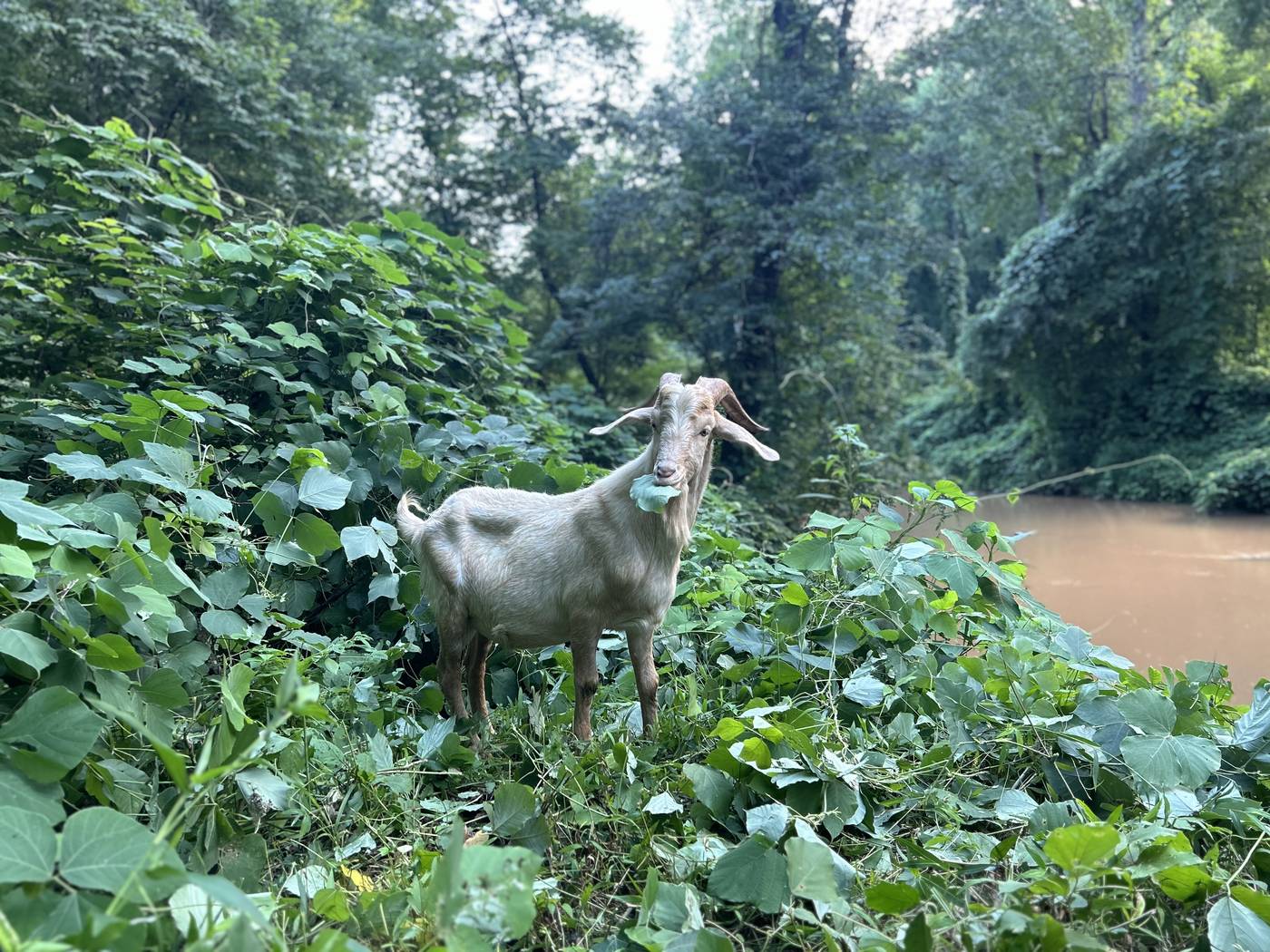
Goats attack the problem from the same direction as repeated mowing, but they can do it on ground no machine can reach, and they don't stop after one pass — they keep grazing regrowth for as long as they're on site.
What that gets you in the first season is dramatic: a wall of kudzu reduced to open ground, sight lines back, fence lines and structures visible again. What it doesn't do is kill the roots outright. Anyone who tells you one grazing eradicates kudzu is selling you something.
A realistic grazing program looks like this:
- Season one: heavy knockback. The visible infestation comes down. Regrowth gets grazed as it appears.
- Season two: return grazing on weaker, thinner regrowth. Root reserves are being spent faster than they're replaced.
- Season three onward: maintenance grazing, or spot treatment of the few crowns that persist.
Two to three seasons is the honest answer for established kudzu. Anyone quoting you one visit and a clear lawn is either inexperienced or hoping you won't check.
What we'd actually recommend, by situation
- Small patch, flat, no water nearby: dig the crowns out yourself. It's free, and it's permanent if you're thorough.
- Open, accessible acreage: herbicide program, or grazing if you want to avoid chemicals. Both work here.
- Steep banks, creek edges, treelines, around structures: grazing. This is the ground where the alternatives run out of road.
- You want it gone and you want it gone properly: grazing to knock it down, then targeted spot treatment of surviving crowns. Combining methods beats being loyal to one.
Timing matters more than people think
Kudzu is most vulnerable when it has spent energy on growth and hasn't yet restocked the roots for winter. Grazing or cutting through the growing season, repeatedly, drains reserves. Letting it run all summer and hitting it once in autumn does far less.
If you're planning to deal with kudzu this year, the time to start is earlier than feels necessary.
Do goats actually eat kudzu?
Enthusiastically. Kudzu is a legume — it's high-protein forage, and goats prefer it to grass. They also eat poison ivy, English ivy, honeysuckle, greenbrier and multiflora rose without any ill effect. Urushiol, the oil that causes the rash in humans, doesn't bother them.
If you'd rather not do it yourself
We clear kudzu across central and western North Carolina.
A working herd of more than a hundred goats, based in Elkin. We'll walk your property, tell you honestly whether grazing is the right tool for it, and give you a realistic multi-season plan rather than a promise we can't keep.