Home/Goatscaping
Our core service
Goatscaping and targeted grazing.
Using a managed goat herd as a vegetation-management tool — on ground where machines are unsafe, unwelcome, or would do more damage than the brush.
What it is
Grazing as a management tool, not a novelty.
Targeted grazing means putting the right number of animals on a defined piece of ground, for a defined length of time, to take a specific type of vegetation down. It's a technique with real agricultural history behind it — the goats aren't a gimmick, they're the equipment.
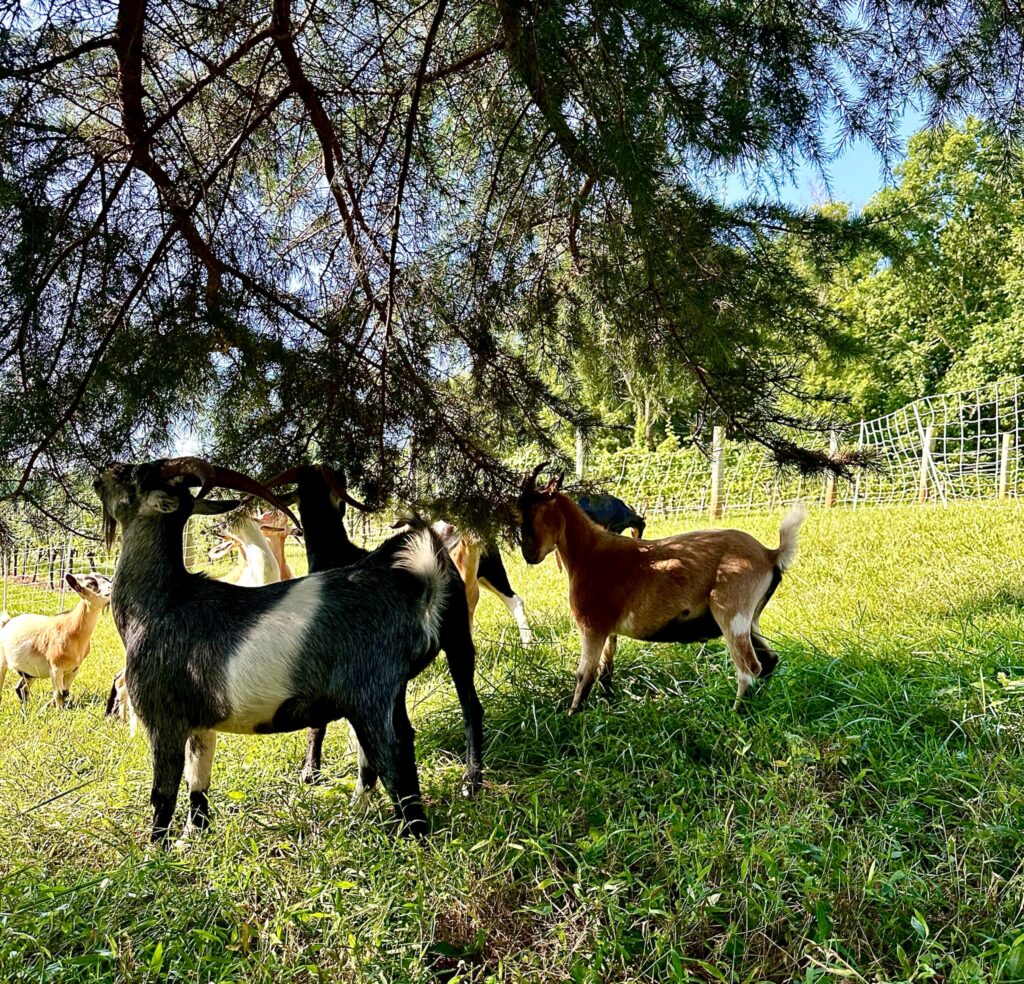
Goats are browsers rather than grazers. Left to choose, they go after shrubs, vines, saplings and broadleaf growth before they touch grass. On a property with a brush problem, that appetite is exactly backwards from a mower's, which is what makes it useful.
They also work ground that costs you money to clear any other way: slopes too steep for a machine to sit on, wet edges you can't drive, rocky ground, and understory you want cleared without losing the canopy above it.
Where grazing is the better tool
- Where machines can't sit level — steep banks and gullies get worked without ruts, compaction or an erosion scar left behind.
- Where spray isn't appropriate — no drift, no re-entry period, no runoff into a pond or creek, nothing to keep kids, pets or livestock away from.
- Where the terrain drives the cost up — a hand crew's price climbs with every degree of slope and every acre of poison ivy. A herd's doesn't, in the same way.
We're not here to run down other contractors — heavy equipment is the right call on plenty of jobs, and we'll say so if yours is one of them. But grazing is a genuinely different proposition: no chemicals, no fuel burned on your property, no soil torn up, and ground held for the long term by animals rather than by a return visit with a machine. If low impact is what you're after, that isn't a marketing angle here, it's the whole method.
Where it isn't the right tool
Grazing won't take out standing trees, stumps or heavy woody stems, and it won't give you a manicured finish. If you need a lawn, you need a mower. If you need a lot cleared to bare dirt for construction, you need a machine. We'll tell you that on the estimate rather than sell you a herd that can't do the job.
Straight answers
The questions everyone asks first.
How long does it take?
As a working figure, ten goats clear about an acre of light-to-medium vegetation in five to seven days. Density, terrain and weather move that number in both directions. We size the herd to your timeline.
What does it cost?
It comes from acreage, how thick the growth is, how hard the site is to access, and how long the herd stays. We quote after walking it — with and without add-on work so you can see what's optional.
Does it grow back?
Some of it will. Goats take top growth, not roots. What repeat grazing does is force the plant to keep spending root reserves, which wears established invasives down over seasons.
What do I have to do?
Nothing. Fencing runs on solar, we bring water if the site has none, and we handle delivery, setup, monitoring and removal. You don't need to be home.
Containment & monitoring
How we keep the herd where it belongs.
Not every project uses every one of these. We match the setup to the site, the length of the job and how remote it is.
Portable electric fencing
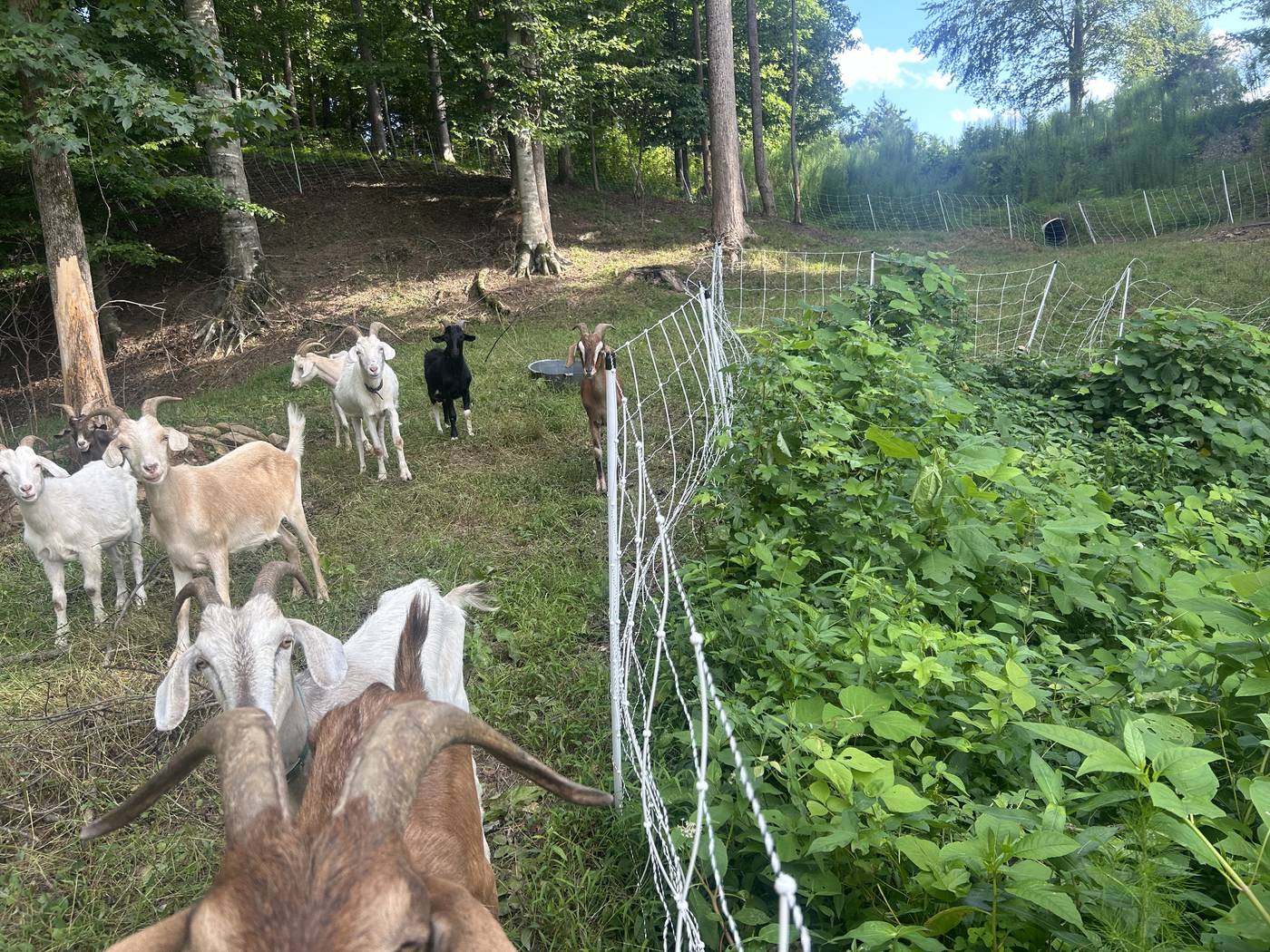
Solar-powered netting sets the grazing boundary and moves forward as sections finish. No power drawn from your property.
GPS virtual fencing
Nofence solar GPS collars let us draw the grazing boundary on a map instead of building it on the ground — which opens up remote and rough sites where hauling netting in isn't practical. Needs cell coverage, and we still use netting where a hard physical line matters.
Livestock guardian dogs
Merry and Denali, our Great Pyrenees, go out on sites where predator pressure or isolation calls for it — not every job needs them. They live with the herd year-round.
Remote cameras
On larger or more isolated sites we set solar-powered cameras so the herd can be checked without a drive out.
Regular site checks
We're on site on a set schedule through the project — water, fence, animal condition, and progress against the plan.
Ready when you are
Let's go look at the property.
An on-site assessment and an honest answer about whether grazing fits your site.