
Field guide
How to get rid of poison ivy without chemicals.
What actually works, what makes it worse, and the one method that carries a genuine risk of serious injury. From people who clear it for a living.
Poison ivy is unusual among problem plants: the difficulty isn't that it's hard to kill, it's that it's hard to approach. Every method that involves a person getting close to it carries a cost, and that cost is why patches sit untouched for years and spread.
The culprit is urushiol, an oil in every part of the plant — leaves, stems, roots, and the hairy vines on tree trunks. It causes a reaction in most people, it stays potent on tools, gloves and clothing for a long time, and dead plants still carry it. Roughly speaking, poison ivy is a plant you can't safely handle even after you've killed it.
The one thing you must never do
Never burn poison ivy. Urushiol travels in smoke. Inhaling it can cause a reaction in the airways and lungs that is a genuine medical emergency, not an inconvenient rash. This applies to brush piles that happen to contain poison ivy too — which is most brush piles cleared off an overgrown property in the Southeast.
If you take one thing from this page, take that one.
Pulling and digging
Effective on small patches, and permanent if you get the roots. It's also the method most likely to send you to urgent care. If you're doing it: full cover, disposable gloves over work gloves, long sleeves taped at the wrists, and everything washed separately afterwards in hot water. The oil transfers to anything it touches, including the outside of the gloves you take off with bare hands.
Cut vines climbing trees at the base and again at shoulder height, and leave the upper section to die in place rather than pulling it down over yourself.
Mowing and string trimming — usually a mistake
A string trimmer through poison ivy produces a fine spray of plant material and oil at head height. People do it, and people regret it. Mowing also fragments the roots, and root fragments produce new plants. You end up with a wider patch and a rash.
Smothering
Cardboard or heavy mulch over a small patch, left for a full season, will weaken it considerably. Slow, cheap, no exposure — good for a defined bed near a house, impractical for a bank or a treeline.
Herbicide, and why people want to avoid it here
Systemic herbicides do work on poison ivy, usually over more than one application. The reason so many people go looking for another option is that poison ivy grows exactly where spraying is least welcome: along the edge of a lawn where children play, around a play set, at the base of trees you want to keep, and along creek banks where runoff is a concern.
Why goats are unusually good at this specific plant
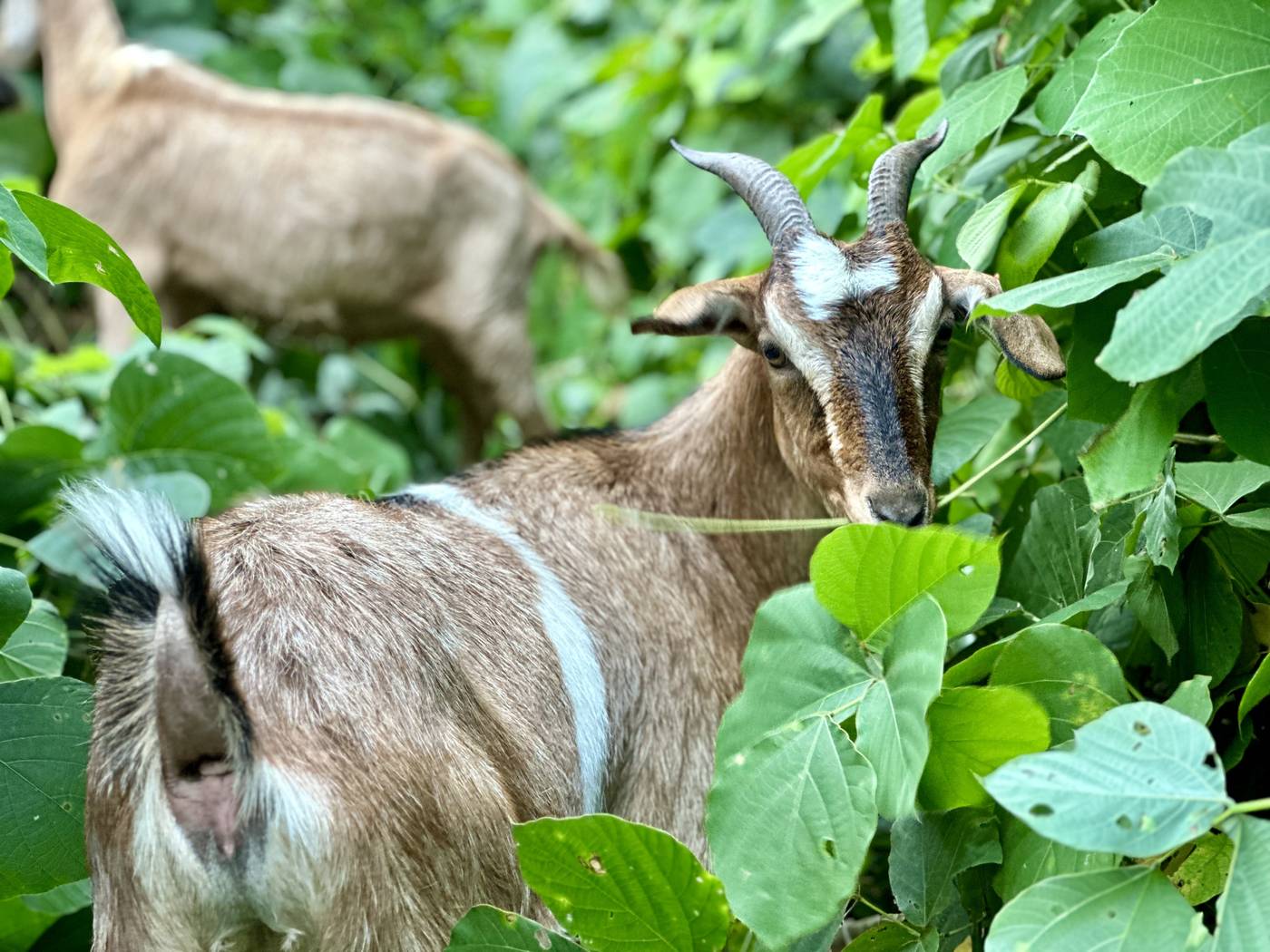
Goats are not affected by urushiol. They browse poison ivy — leaves, stems and vine — as readily as anything else, with no reaction and no ill effect. It doesn't taint their meat or milk, and it doesn't harm them.
That single biological fact removes the entire problem. The hazard in poison ivy control is human exposure. Take the human out of the equation and it becomes ordinary vegetation management.
What that means in practice on a property:
- No one has to get close to it, before, during or after.
- No burning, no fragmenting, no oil on tools and clothes.
- The vine gets browsed at the base of trees and up to browse height, which is where most of it lives.
- No spray near the play set, the vegetable garden, the well or the creek.
The honest limit is the same as with any grazing: goats remove top growth, not roots. A heavily established patch will push new growth, and the answer is repeat grazing rather than a single visit. For most residential poison ivy — an overgrown bank, a fence line, the edge of the woods behind the house — one grazing gets it out of the way and a follow-up keeps it there.
If you've already been exposed
Wash the skin with soap and cool water as soon as you can — the sooner the oil comes off, the less reaction you get. Wash clothing separately in hot water, and wipe down tools, gloves, boots and anything else that touched the plant. Pets can carry the oil in on their coats without reacting themselves.
See a doctor for a severe reaction, for a rash near the eyes or over a large area, and immediately for any breathing difficulty after being near burning brush.
Does poison ivy come back?
If the roots survive, yes. That's true of pulling, mowing, grazing and most single herbicide applications. Anything that promises one-and-done on established poison ivy is overselling. Plan on a second pass and you'll be pleasantly surprised rather than disappointed.
Rather not go near it?
We clear poison ivy across central and western North Carolina.
A working herd of more than a hundred goats, based in Elkin. No spray, no burning, and nobody in your family has to get within ten feet of it.