Field guide
How to get rid of English ivy in North Carolina.
It doesn't just cover ground — it climbs, and it kills the trees it climbs. Here's what works, what makes it worse, and why winter is a good time to deal with it.
Most people treat English ivy as a groundcover that got out of hand. The ground is the least of it. Ivy's real damage happens vertically.
Once ivy reaches a trunk it climbs, and once it's high in the canopy it changes form — it stops running and starts producing woody stems, flowers and berries. Two things follow. The weight and sail area make a mature tree far likelier to come down in wind or an ice storm, which in this part of North Carolina is not a hypothetical. And the berries get eaten by birds and dropped across the neighbourhood, which is how one ignored patch becomes everyone's problem.
If you do nothing else this year, get the ivy off your trees. The ground can wait. The trees can't.
The cut that saves the tree
Arborists call it a lifesaving cut, and it's the highest-value hour you'll spend on ivy. Cut every ivy stem at the base of the trunk, then cut again at about shoulder height and remove that band of growth completely, so the two halves can't rejoin.
Then leave the upper section alone. It will die in place over the following weeks and months and eventually fall away on its own. Do not pull it down.
Why pulling ivy off bark is a mistake
Ivy grips with rootlets that bond hard to bark. Ripping a live vine off a tree takes bark with it, and on a thin-barked tree that's real injury. On brick, stone and siding, the same thing happens to mortar and paint. Kill it in place and let it release on its own — it takes patience and it does far less damage.
Why it comes back after you clear the ground
English ivy re-roots from stem fragments. Every piece left behind after mowing, trimming or a rushed hand-pull is a potential new plant, sitting on soil, in shade, in a climate it likes. That's why the ground looks clear in April and looks like ivy again by August.
It's also why mowing is close to useless on established ivy — you're not removing it, you're propagating it. Whatever method you use, the material has to come out or be repeatedly knocked back, not chopped up and left.
Why herbicide underperforms on ivy specifically
Ivy leaves have a thick waxy cuticle built to shed water — which also sheds spray. It's the main reason people who have had good results on other weeds find ivy disappointing. Applications are usually repeated, often with a surfactant, and results are still slower than on softer-leaved plants.
It also grows exactly where people are most reluctant to spray: at the base of trees they want to keep, up against foundations, along property lines and creek banks. As always, ask your county Cooperative Extension office before spraying near water.
Hand-pulling, and when it's genuinely the answer
On a small patch, pulling works and it's permanent if you're thorough. Ivy's surface roots come up reasonably well in damp soil. Collect every fragment — don't compost it, and don't leave a pile on bare ground. On anything larger than a bed or two, hand-pulling stops being realistic quickly.
Where goats fit
Goats browse English ivy readily. On a bank, a treeline, a wooded edge or a neglected lot, a herd removes the standing growth without anyone hauling bags out or touching a trunk with a tool.
Two honest limits. Grazing removes leaves and stems, not the root system, so established ivy pushes new growth — this is a multi-season plant, and anyone telling you one visit ends it is overselling. And goats work to browse height, so the ivy already high in a canopy still needs that lifesaving cut at the base; once cut, it dies up there regardless.
What grazing does well is the hard part: large areas of dense ivy on ground that's steep, wooded or awkward, cleared without spray, without fragments scattered around, and without a crew spending days in it.
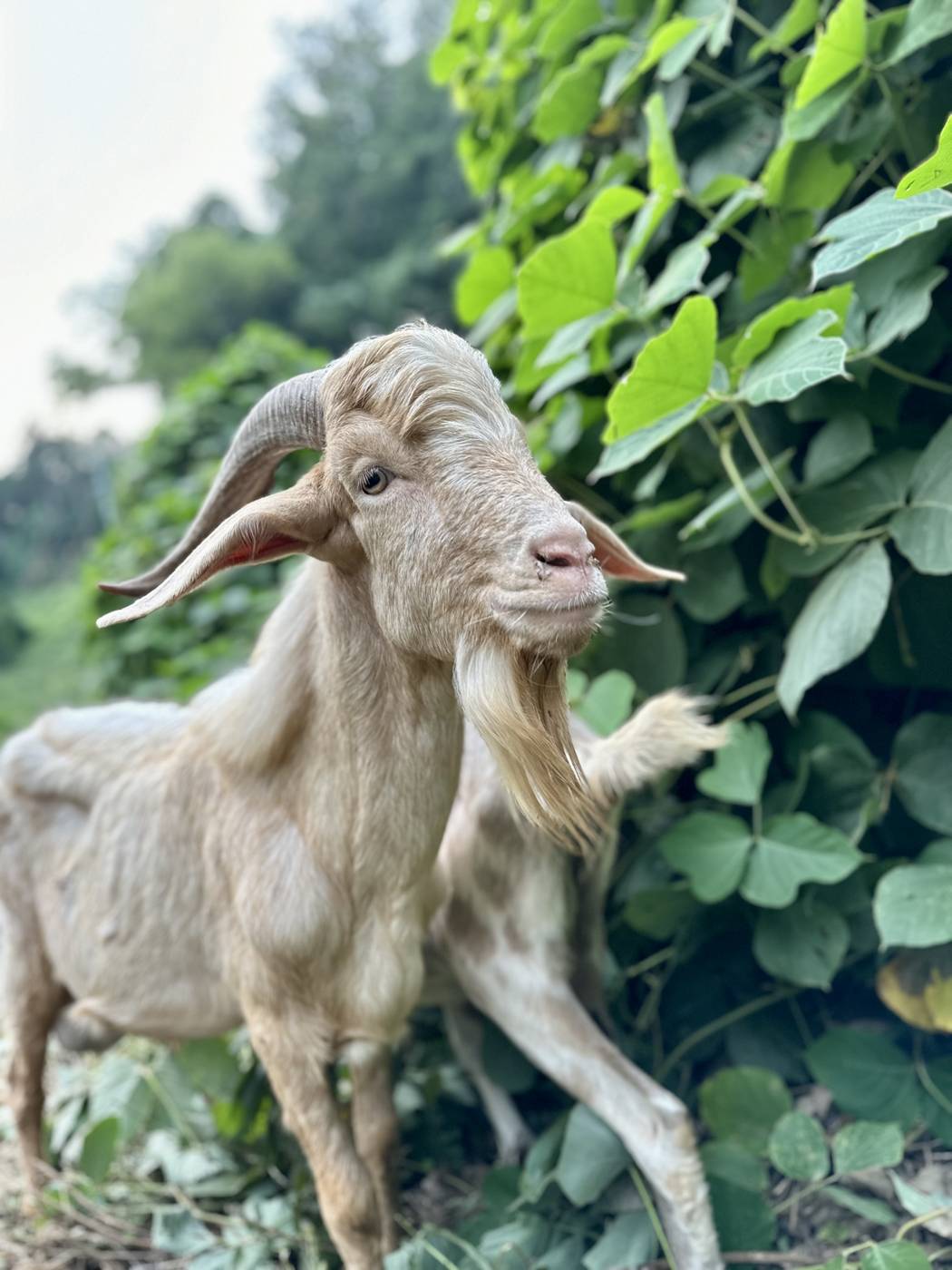
Ivy is one of the few jobs that works in winter
English ivy is evergreen. While almost everything else on a property is dormant and leafless, ivy is still green, still growing and still climbing — which makes it one of the few vegetation problems that can genuinely be worked in the off-season.
We take ivy jobs through the winter, and there are practical advantages to going then. With the surrounding growth died back, the ivy is easy to see and easy to reach; the extent of it on a treeline is obvious in a way it never is in July. Scheduling is easier in our quieter months. And clearing it over winter means the property starts the growing season already ahead instead of already behind.
If you've been looking at an ivy-covered bank all summer and putting it off, winter is a better time to deal with it than you'd think.
A realistic plan for an ivy-covered property
- First: the lifesaving cut on every tree with ivy climbing it. This is urgent in a way the rest isn't.
- Then: clear the ground growth — grazing on larger or awkward areas, hand-pulling on small beds.
- Season two: return to the regrowth while it's thin. This pass is much easier than the first and it's the one people skip.
- Ongoing: watch the edges. Ivy comes back in from fence lines, neighbouring yards and anywhere birds drop berries.
Is English ivy actually illegal to plant?
It's widely recognised as invasive across the Southeast and it's on plenty of do-not-plant lists, but rules differ by state and locality and they change. If that matters for your property, your county Cooperative Extension office will tell you where things currently stand in North Carolina.
If it's beyond hand-pulling
We clear English ivy across central and western North Carolina.
A working herd of more than a hundred goats, based in Elkin. We'll walk the property, tell you which trees need attention first, and give you a plan that accounts for the second season rather than pretending there won't be one.